

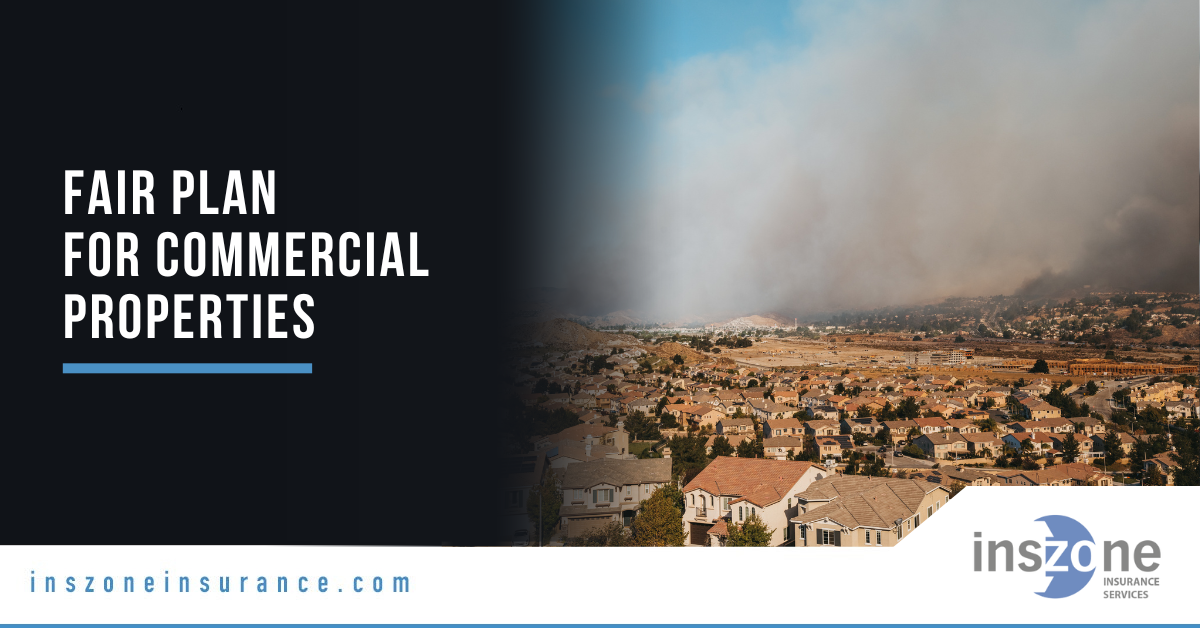
Finding commercial property insurance in California has become increasingly challenging due to heightened wildfire risks and the tightening of the commercial insurance market. Property investors, developers, and business owners may need to consider the state’s high-risk insurance pool, known as the California FAIR Plan, which provides fire insurance when traditional carriers refuse coverage.
Here is a breakdown of what business owners and property managers need to know about securing FAIR Plan coverage for their commercial assets.
What is the California FAIR Plan?

The California FAIR (Fair Access to Insurance Requirements) Plan is a last-resort insurance program designed to provide basic fire insurance coverage to businesses unable to secure policies from private insurers.
Contrary to popular belief, the FAIR Plan is not a state-run program; rather, it is funded by insurance companies that are licensed to operate in California. These carriers share the risk for high-risk properties, including commercial buildings, agricultural facilities, and retail centers in wildfire-prone areas.
Maximizing Coverage: Commercial Limits Have Significantly Increased
Historically, commercial entities struggled with the FAIR Plan because the coverage limits had not been updated in over two decades. However, significant expansions have transformed the program’s viability for larger businesses.
In 2023, Commissioner Ricardo Lara pushed to more than double the existing options, raising the Division I Commercial Property Program (previously capped at $8.4 million) and the Division II Business Owners Program (previously capped at $7.2 million) to $20 million per location.
Since then, limits have expanded even further. As of mid-2025, the FAIR Plan introduced a “Commercial High Value” (CHV) policy option. This new structure allows for up to $20 million in coverage per building, with a total maximum limit of $100 million per location. This increased capacity provides a crucial lifeline for larger commercial developments, including:
- Habitational buildings (apartment complexes, hotels, motels).
- Retail establishments and shopping centers.
- Office buildings and manufacturing facilities.
- Commercial farms and wineries.
- Buildings actively under construction.
What Does the California FAIR Plan Cover for Commercial Properties?
The FAIR Plan for commercial properties offers limited, peril-specific coverage for losses resulting from:
- Fire.
- Lightning.
- Smoke.
- Internal explosions.
However, it is important to understand that the FAIR Plan provides only basic fire-related protection. Businesses should be aware that the plan does not cover:
- Theft.
- Water damage.
- Earthquakes.
- Falling objects.
- Business interruption or lost income.
To fill these gaps, businesses will often need to purchase additional policies. A Difference in Conditions (DIC) policy provides more comprehensive protection, including coverage for theft and water damage. Furthermore, a Commercial General Liability (CGL) policy is strictly necessary to cover business operations-related risks, such as slip-and-fall accidents on the premises.
Commercial Risk Mitigation and the FAIR Plan
One of the biggest changes to the FAIR Plan in recent years is the focus on risk mitigation. As wildfire risks increase, business owners may be required to take steps to reduce their property’s vulnerability.
Some of the most common mitigation requirements include:
- Installing fire-resistant roofing and vents.
- Creating defensible spaces around commercial buildings by clearing brush and debris.
- Updating outdated electrical wiring or HVAC systems.

In return for these capital improvements, some commercial properties may qualify for discounts on their FAIR Plan premiums. Conversely, properties that receive unsatisfactory safety inspections may incur substantial surcharges.
Proposed Changes and Future Outlook for Business Owners
The California Department of Insurance (CDI) regularly reviews the FAIR Plan, leading to ongoing operational shifts that directly affect commercial property owners:
- Wildfire Damage Expansions: Recent expansions clarify coverage for smoke damage and damage caused by fire suppression efforts, which is crucial for businesses affected by nearby wildfires.
- Cannabis-Related Businesses: AB 741 is a legislative effort that would prohibit the FAIR Plan from refusing to issue or renew coverage simply because an applicant is a commercial cannabis licensee, aiming to support this growing sector in California.
- Percentage-Based Deductibles: The new Commercial High Value (CHV) policies now utilize percentage-based deductibles (ranging from 1% to 15% of the total insured value) rather than flat-dollar amounts, meaning businesses must carefully calculate their out-of-pocket exposure in the event of a major claim.
Conclusion
The California FAIR Plan offers a critical safety net for property investors and business owners who struggle to secure commercial property insurance. However, it is not a complete solution on its own.
It is essential to supplement FAIR Plan coverage with additional policies tailored to your daily operations and unique liabilities. If you have questions about how the FAIR Plan works for commercial properties or need assistance navigating the new $100 million location limits, our team of commercial insurance brokers is here to help. Contact us today to get started.

Larry Jeffery

